


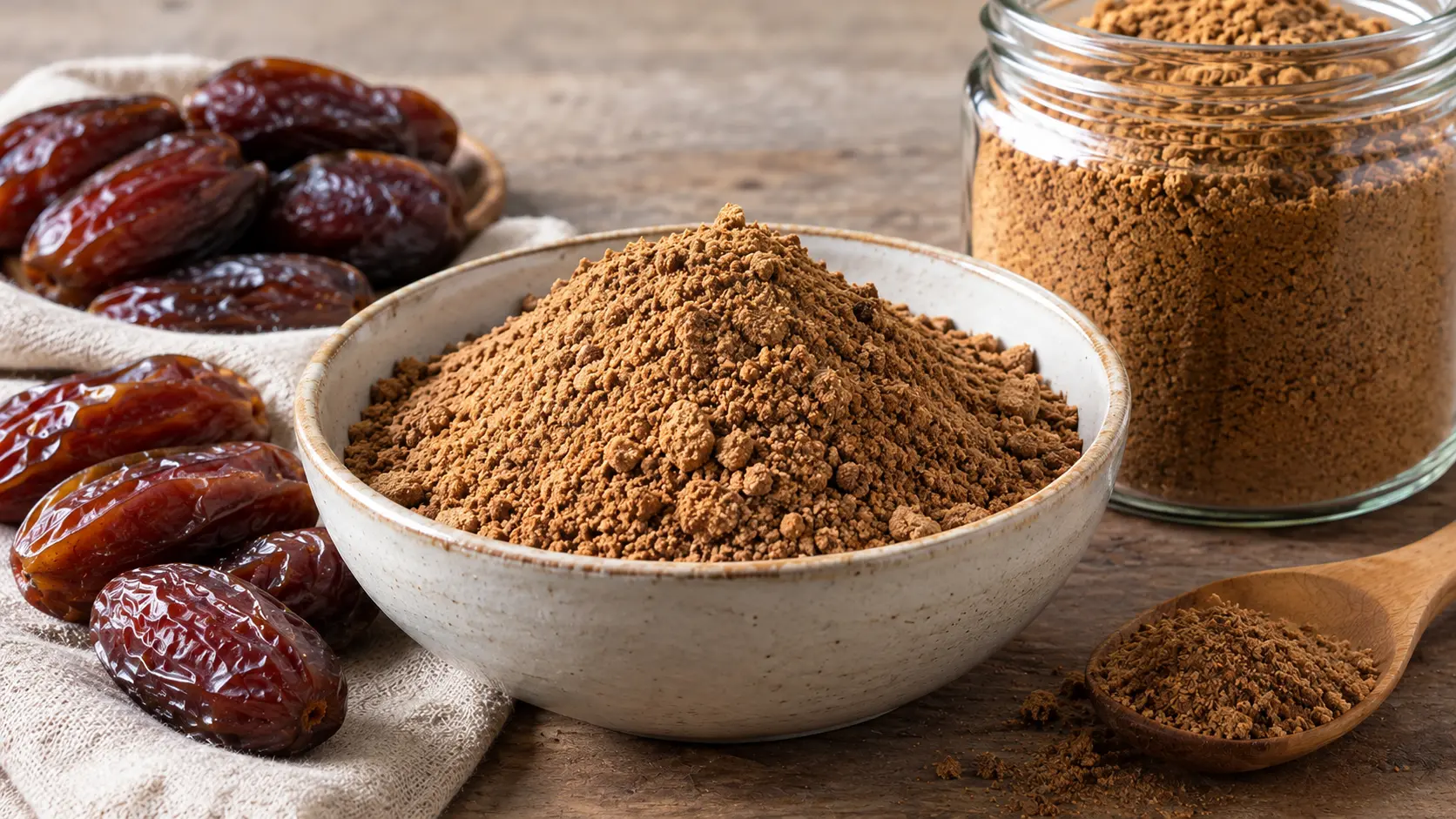
A practical guide for food manufacturers evaluating date powder for bakery, cereals, bars, fillings and other formulated products.
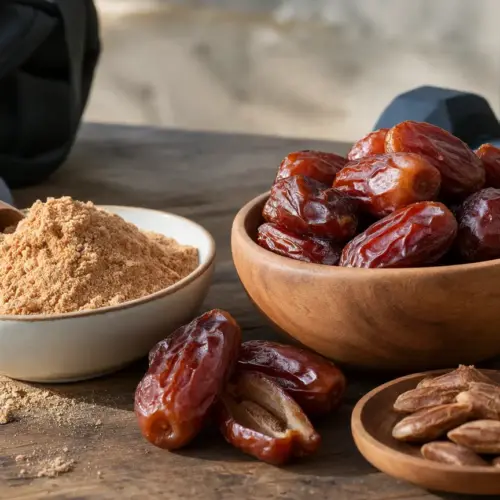
Date powder—also sold as date sugar—is made by drying and milling whole dates. It provides sweetness, but it also brings fruit solids, fibre, colour and a recognisable caramel-fruit profile.
Those additional functions can be useful in the right product. They also mean that date powder should not be treated as a drop-in replacement for refined sugar.
For product developers and procurement teams, the relevant question is not simply whether the ingredient is “natural”.
The decision should be based on product fit, process tolerance, supplier specification, target claims and the performance of the finished formulation.
What date powder contributes beyond sweetness
Dates are naturally rich in glucose and fructose, while the whole-fruit solids also contribute fibre, minerals and phenolic compounds.[1]
In a powder, the balance varies with date variety, maturity, drying conditions, milling and storage. A supplier specification is therefore more useful than a single generic composition value.
Composition of an oven-dried date powder sample (Assous et al.)[2]
| Component | Value | Why it matters |
| Glucose | 32.55 g/100 g | Sweetness and browning |
| Fructose | 30.29 g/100 g | Sweetness and hygroscopicity |
| Sucrose | 2.67 g/100 g | Most sugar is present as glucose and fructose |
| Crude fibre | 7.67% | Texture and water retention |
| Moisture | 2.53% | Shelf stability and flow |
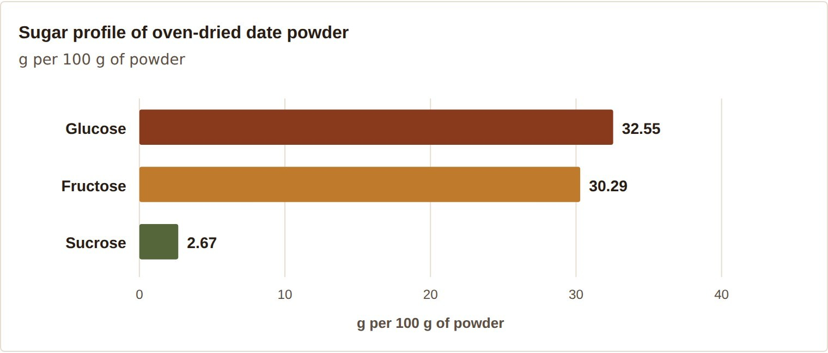
Figure 2. Glucose and fructose dominate, which contributes to the strong browning. Source: Assous et al.[2]
Why use date sugar?
Date sugar is commonly used as another name for date powder.
The strongest reason to use it is not an automatic “healthier” positioning. It is that a whole-fruit powder can provide sweetness together with fibre, minerals and fruit-derived compounds, whereas refined white sugar provides almost entirely sucrose and energy.
The comparison below is indicative. USDA data list granulated sugar at about 387 kcal and 99.98 g of carbohydrate per 100 g.[3]
Published date-powder composition varies by variety and process. For example, a 2024 study of Bisr Al-Khalas date powder reported 82.59% carbohydrate, 10.20% crude fibre, 2.50% protein, 0.77% fat and 11.84% moisture.[4]
Commercial decisions should use the supplier specification for the actual lot.
| Per 100 g | Refined white sugar | Date powder — indicative |
| Energy | About 387–400 kcal | Often about 340–360 kcal; verify the product specification |
| Total carbohydrate | About 100 g | Commonly about 75–83 g |
| Total sugars | About 100 g, mainly sucrose | High and variable; mainly glucose and fructose |
| Fibre | 0 g | Often about 6–11 g (crude fibre in the cited studies; request dietary fibre from the supplier) |
| Protein | 0 g | About 2–3 g |
| Fat | 0 g | About 0.5–1 g |
| Minerals | Negligible | May include potassium, magnesium, calcium and iron |
| Fruit-derived compounds | Negligible | May include phenolic and antioxidant compounds |
What changes in the finished baked product?
Partial replacement can increase fibre and may contribute small amounts of protein, minerals and polyphenols.
The size of that change depends on the substitution level and the rest of the recipe. It must be calculated from reliable ingredient data and, where a claim is planned, confirmed for the finished product.
A slightly lower energy value for the ingredient does not guarantee a meaningful calorie reduction in the finished product.
The same 2024 biscuit study found that increasing Bisr date powder increased moisture, ash and fibre.
A 25% replacement did not negatively affect sensory acceptance, while biscuits made with 100% date powder were less accepted.[4]
This supports partial replacement as a more controlled starting point, especially for crisp biscuits and delicate cakes.
Technological impact in baked goods
Date powder also changes how a baked product behaves during processing and storage.
Its fibre and fruit solids can bind more water and increase moisture retention. The powder can produce a darker colour, a stronger browning response and a fruity, caramel-like flavour.
In biscuits, it may alter spread and texture or reduce crispness when water and baking conditions are not adjusted.
These effects should be measured against the control rather than treated as automatic benefits or defects.
For biscuits, the relevant checks include dough consistency, piece dimensions, break force, colour, moisture, water activity and sensory acceptance.
Partial replacement is usually easier to control than direct 100% substitution.
| Defensible B2B positioning – Replacing refined sugar with date powder can increase the fibre and mineral content of a baked product while adding a distinctive fruity and caramel-like flavour. – Date powder remains a carbohydrate-rich ingredient containing naturally occurring sugars; its contribution depends on the complete formulation, substitution level and specification of the powder used. |
Where date powder works best
Date powder is easiest to formulate where colour and flavour are part of the product concept.
It is less straightforward in white creams, clear beverages or products that require complete dissolution. The ranges below are starting points for pilot work, not universal recommendations.
| Application | Pilot range | Primary checks |
| Biscuits and cookies | 10–30% of sugar replaced | Spread, hardness, colour, water activity |
| Cakes and muffins | 10–20% of sugar replaced | Volume, crumb softness, flavour balance |
| Cereal and granola products | 3–10% of total formula | Coating, clumping, browning |
| Snack and energy bars | 10–25% of total formula | Binding, stickiness, water migration |
| Fillings and plant-based desserts | 2–8% of total formula | Smoothness, aftertaste, sediment |
| Chocolate and compound coatings | 2–10% of total formula | Particle size, viscosity, grittiness |
How far can it replace refined sugar?
Partial replacement is the most controlled route.
A 2022 biscuit study compared 20%, 30% and 50% replacement and reported increasing water absorption as date powder increased; the 30% formulation was the most acceptable among the tested replacement levels.[5]
A broader review of date ingredients in baked goods also shows that product response depends on the date material, recipe and processing method.[6]
For an industrial project, begin with a control and two or three replacement levels.
Keep the first screening trial simple, then adjust water, mixing or the bake only after the effect of the powder is visible.
For a step-by-step protocol, see How to Replace Sugar with Date Powder in Biscuits: A Technical Trial Guide .
Processing and quality controls
Incoming ingredient controls
Ask for particle-size distribution, moisture, sugar profile, microbiological limits, allergen status, bulk density and storage guidance.
Use one lot throughout a development series. Lot changes can alter flow, dosing and dough consistency even when the ingredient name remains the same.
Mixing, forming and thermal process
Compare the trial against the control at the same process settings before making corrections. Monitor mixing endpoint, machinability, piece weight, spread, colour and exit moisture.
Because date powder changes the reducing-sugar profile, reassess acrylamide when it is used in biscuits and other fine bakery wares.
EU Regulation 2017/2158 requires relevant manufacturers to apply mitigation measures and verify their effectiveness.[7]
Shelf life
A successful day-one result is not enough.
Check water activity, moisture migration, texture drift, flavour stability and microbiological performance in the intended packaging.
Powder storage also matters: use moisture-barrier packaging and define acceptable caking or flow limits at goods-in.
Labelling and claims in the European Union
Sugars naturally present in date powder count toward the “of which sugars” value in the nutrition declaration under Regulation (EU) No 1169/2011.[8]
When date powder is added for sweetening, a “with no added sugars” claim is not appropriate because that claim excludes foods used for their sweetening properties.
A “reduced sugars” claim requires at least 30% less sugar than a similar product and the finished product must not provide more energy than the comparator.[9]
Factual wording such as “made with date powder” or “sweetened with dates” may be suitable when it accurately reflects the recipe and the overall presentation is not misleading.
Claims such as “source of fibre”, “organic” or “reduced sugars” require validation against the final product, target market and, where relevant, certification.
Avoid presenting date powder as a sugar-free or inherently healthier ingredient.
| A B2B supplier checklist – A current technical data sheet and certificate of analysis for the supplied lot. – Defined particle-size range, moisture limit, microbiological criteria and contaminant controls. Documented origin, date variety – or blend policy, production method and traceability. – Packaging, minimum order quantity, lead time and shelf-life information. – Application support for pilot trials and a clear change-notification process. |
Plan the trial around the finished product
Date powder is most useful when its sensory profile and fruit solids support the product concept.
Treat it as a multifunctional ingredient, define a realistic replacement target and validate the finished product before making claims.
For a commercial trial, request a sample from one identified lot together with the technical data sheet and certificate of analysis.

 English
  Spanish
  French
  Italian
  German