


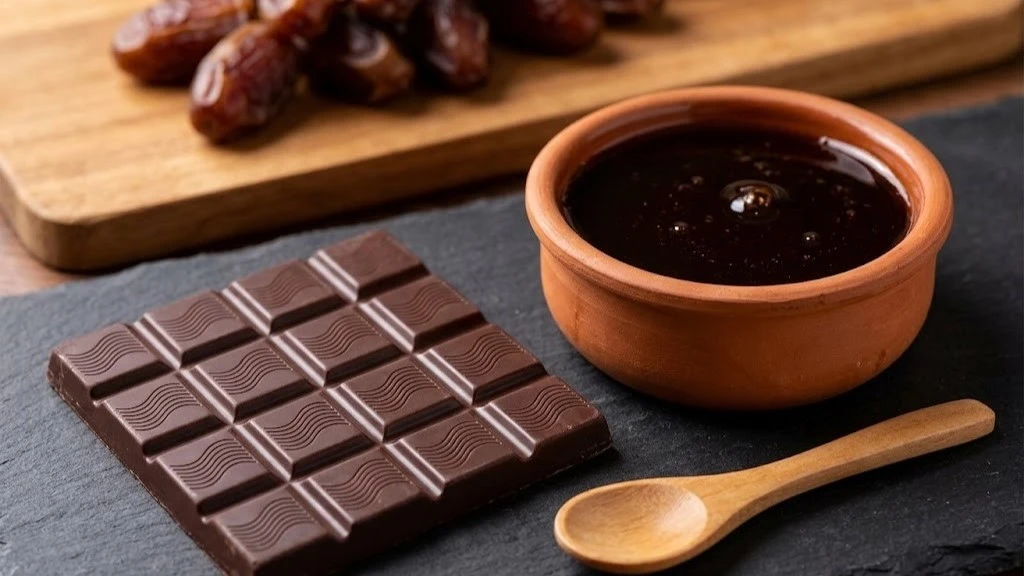
Formulation reference for caramel sauces, ice cream, biscuits, bars and beverages
1. Why Date Syrup Is Winning Over Food Manufacturers
Sticky, dark and intensely aromatic, date syrup has quietly evolved from health-food shelves into mainstream product development, and science has caught up to the appeal.
Date syrup delivers sweetness, a deep caramel colour and a genuine date aroma — precisely the attributes that have driven R&D interest. Peer-reviewed research treats it as a formulation ingredient, not a sugar-free wonder: it’s largely composed of glucose and fructose, and its exact profile is dictated by which dates went in, how the syrup was extracted, and how far it’s been reduced. What follows is a synthesis of that research, drawing together composition data, sensory behaviour, category-by-category notes, a few recipe starting points, and the sourcing questions worth asking before signing off a batch with a supplier.
2. The Scientific Evidence
A 2023 review examined date-derived sweeteners as a viable replacement for refined sugar, citing the minerals, phenolic compounds and — in some products — dietary fibre that accompany the carbohydrates. The same paper listed a range of products already using these sweeteners in their formulations: beverages, confectionery, desserts, baked goods, dairy — a promising indication for date syrup as a natural sweetening and flavouring ingredient. It’s not a claim that every commercial syrup on the market shares the same nutrition numbers [1].
A 2023 study on Barhi-date syrups made a more practical observation. Extraction and evaporation method alone shifted moisture, viscosity, colour and antioxidant readings in syrups distilled from the same variety of date. In the open-heated batches, carbohydrate content ranged from roughly 61.5 to 69.1 g per 100 g, and total sugars from 58.4 to 71.3 g, depending only on the processing [2]. For a buyer, that’s the entire story in one sentence: ask for a supplier’s own specs, rather than a number pulled from an outside variety or process.
3. Nutritional Composition — Technical Reference
The ranges below are drawn from three Barhi-date syrups — same fruit, different extraction routes, all evaporated by open heating in one published trial. They are reference values from that specific experiment, not a nutrition declaration to be tacked to every date syrup that comes through the door [2].
| Component | Reported range / 100 g | Formulation interpretation |
| Moisture | 27.63–36.16 g | Determines concentration, viscosity and water balance |
| Protein | 0.81–0.96 g | Present in trace amounts |
| Fat | 0.00 g | Not detected |
| Total carbohydrates | 61.49–69.14 g | Main macronutrient fraction |
| Total sugars | 58.35–71.27 g | Primary source of sweetness |
| Dietary fibre | 0.87–0.98 g | Mostly soluble |
| Energy | 249.14–280.06 kcal | Varies with carbohydrate and moisture content |
| Ash | 2.05–2.97 g | Depicts mineral residue |
These figures come from the CO, PO and VO open-heated samples in Table 4 of Julai et al. (2023) [2]. Glucose and fructose made up most of the sugar; sucrose turned up in only one of the three samples.
4. The Sensory Experience: Colour, Aroma, Sweetness
Great flavour isn’t an accident — it’s chemistry you can actually taste.
Deglet Nour date syrup tends to run amber to dark brown, carrying a pronounced date aroma, honey-like sweetness and enough body to coat a spoon. Studies on the phenolic compounds and flavonoids in Deglet Nour dates link the composition to measurable antioxidant activity, and to the fruity, caramel-like, faintly roasted notes that repeat themselves in finished products [10–12].
There’s a ceiling to how much of that character helps, though. Push the dosage too far and the syrup’s own sugar load becomes a liability — the product runs the risk of tasting cloying, or the texture becomes more sticky than smooth. Where this point falls is dictated by concentration, how hot the mix is during processing, and what the syrup is sitting next to. Fat, cereal, milk protein and chocolate all pull the flavour in a different direction.
This section draws on phenolic-composition and antioxidant studies of Deglet Nour and Tunisian date varieties. Exact colour, aroma and flavour intensity vary with production method, heating and storage — the cited studies describe composition and behaviour, not a therapeutic effect in humans.
5. Where Date Syrup Performs Best
From glossing up a caramel drizzle to the perfect cookie snap, here are the applications where date syrup earns its place on the ingredient label.
Date syrup doesn’t behave the same way twice. What it does in a caramel base is different from what it does inside a biscuit dough, and the table below is a starting map rather than a rulebook — the section for each application includes what actually happens on the bench, rather than repeating the table in sentence form.
| Application | Potential contribution | Parameters to validate |
| Caramel sauces | Sweetness, colour, date flavour, soluble solids | Viscosity, water activity, stability, separation |
| Ice cream & frozen desserts | Sweetness, colour, date character | Freezing point, overrun, viscosity, sensory acceptance |
| Biscuits & bakery | Sweetness, browning, moisture contribution | Spread, crispness, water balance, shelf life |
| Bars & fillings | Binding, sweetness, fruit identity | Texture, migration, stickiness, packaging |
| Beverages & dairy | Sweetness, flavour differentiation | Solubility, sedimentation, acidity, heat stability |
5.1 Caramel Sauces: Silky, Glossy and Naturally Sweet
In an industrial caramel, date syrup delivers three functions that traditionally would have needed three separate ingredients: sweetens, browns and brings a genuine fruit note that sits well with tahini, coffee, cocoa, nuts or dairy. Because it already carries soluble solids and its own viscosity, formulators often find they need less added thickener than expected. The trade-off shows downstream — final texture is determined by concentration, heat treatment, water activity, fat phase and whatever stabilising system is in play, so those are the variables to lock down at the pilot kitchen level.
5.2 Ice Cream & Frozen Desserts: A Natural Sugar Alternative
Gheisari, Heydari and Basiri (2020) compared sucrose, date pulp, date liquid sugar and combinations of the three in an ice-cream formulation [3]. Replacing half the sugar with liquid date sugar moved the antioxidant number without harming colour; replacing all of it moved both acidity and viscosity while cutting colour acceptance [3].
The lesson for a formulator isn’t yes/no, but how much. Freezing, perceived sweetness, viscosity and colour acceptance all move with the substitution rate, so a ripple running through the base — or a partial replacement — tend to be gentler starting points than a straight one-to-one swap.
5.3 Biscuits & Bakery: Sweetness with Golden Colour
Majzoobi et al. (2016) studied the effect of replacing sucrose with date syrup and date liquid sugar at several levels in biscuit dough [4], and the findings are worth remembering: liquid date ingredients change moisture and sugar at the same time, not sweetness on its own, so spread, texture, colour and crispness don’t follow a predictable line because sweetness is being matched.
In practice, that means dough water, baking temperature, piece weight and packaging need a second look once date syrup enters a cookie, cereal bar, cake or filling recipe. The extra moisture continues to work on the product long after it leaves the oven, via migration and shelf life.
5.4 Bars & Fillings: Natural Binding, Real Fruit Flavour
Bar and filling systems ask something slightly different of date syrup: to bind as much as it sweetens. Its viscosity and sugar profile hold particulates together while the fruit identity serves its own purpose on-pack, particularly against artificial-sweetener claims. Where things go wrong is after mixing — moisture migrates between the syrup and the dry ingredients over time, softening texture or introducing stickiness, so packaging properties and a storage trial deserve as much attention as the original recipe ratio.
5.5 Beverages & Dairy: Smooth Solubility, Clean Sweetness
In a liquid system, flavour is only half the job — how the syrup dissolves and stays there is just as critical. Solubility, sedimentation risk and stability through pasteurisation or UHT treatment determine whether date syrup can go directly into a beverage or dairy base. Its natural acidity is worth checking against the product’s own pH target, as it can shift stability or shelf life only once the batch is already in the tank.
6. Recipe Concepts to Try in R&D
Ready to experiment? These four starter formulas are designed to get your R&D bench moving.
These four ideas are pilot-trial starting points, not finished industrial recipes — treat the ratios as a first draft to adjust against the actual syrup’s Brix, moisture, viscosity and sugar profile.
6.1 Date Caramel Sauce — Desserts and Bakery
- Base: date syrup + cream or coconut cream + a small fat addition + vanilla + sea salt
- Process: gentle heating to target viscosity, then cool and assess sweetness, colour, water activity and separation
- Fit: ice cream toppings, cheesecake, pancakes, pastries, filled biscuits
6.2 Date-Syrup Ice Cream or Gelato Base
- Base: date syrup within the sweetener system, combined with a milk or plant-based base
- Process: balance total solids, freezing point and viscosity; consider a ripple format to preserve flavour, or partial replacement to protect colour and acceptance
- Test: overrun, scoopability, melt-down behaviour, storage stability
6.3 Date and Tahini Dessert Sauce
- Base: date syrup + tahini + water or plant-based milk + lemon juice + a pinch of salt
- Fit: dairy desserts, vegan bowls, bakery fillings, snack coatings
- Test: emulsion stability, viscosity, sweetness balance, sesame flavour intensity
6.4 Date-Syrup Biscuit or Cookie Formulation
- Base: partial sucrose replacement with date syrup, added liquid reduced accordingly
- Effect: increased browning and moisture, increased date note
- Test: spread, crispness, internal moisture, colour and shelf life versus a sucrose control
7. How to Source Date Syrup You Can Trust
Not all date syrup is created equal — here’s what sets a dependable supplier apart from a risky one.
A single figure of sweetness or colour isn’t enough to commit to a commercial volume — ask for the full technical file instead. What dictates fit for a specific application is the combination: date variety or raw-material description, Brix, moisture, pH, sugar profile, viscosity, microbiological limits, an allergen statement, packaging format and shelf-life conditions. Skipping any one of these makes it easy to end up with a syrup that has good numbers on the bench, but behaves differently on the line.
A supplier who can hand over the same technical data sheet batch after batch, alongside representative samples, is worth more long-term than one competing purely on price. Extraction and evaporation method genuinely shift colour, viscosity, sugar concentration and antioxidant readings [2], so running the supplied lot through a pilot trial remains the most reliable way to know how it will perform before a full production run.
8. Real-World Proof: A Date-Sweetened Ice Cream Brand
Sometimes the best proof isn’t a lab report — it’s a brand that already sells it.
Frankie & Jo’s, an ice-cream brand based out of Seattle, has two date-sweetened products on sale: Chocolate Date, a chocolate coconut-milk ice cream sweetened only with dates, and Date Shake, a vanilla ice cream that uses maple syrup together with dates [7]. It’s a commercial example, not a scientific study, but it demonstrates the application model in action — pairing a recognisable date ingredient with a clear flavour concept to support plant-based, premium positioning.
The lesson that transfers is about process, rather than the specific product: pick a flavour concept, build it around date syrup, then validate sweetness, texture, nutrition and shelf life at pilot scale before anyone talks about scaling up.
9. The Bottom Line
Bottom line: date syrup isn’t a sugar substitute — it’s a flavour upgrade backed by data.
The research makes a pretty clear case for date syrup’s place as a natural sweetening ingredient, and it delivers more than sweetness — colour, a distinct flavour and formulation value, whether it’s a caramel sauce, an ice-cream base, a biscuit dough or a bar filling. Nutritionally it’s carbohydrate-led, with smaller, process-dependent amounts of minerals, protein and fibre accompanying the reduction.
Honest positioning — presenting date syrup as a date-derived sweetener, not a sugar-free one — holds good commercial case. What decides whether a specific syrup works in a specific product is the same short list: Brix, viscosity, sugar concentration, moisture, colour, sensory performance, shelf life. Test against those before locking in a formulation.
References
[1] Is the Date Palm Fruit a Natural Alternative to Sweeteners? — https://pmc.ncbi.nlm.nih.gov/articles/PMC10778573/
[2] Effects of Extraction and Evaporation Methods on Physico-Chemical, Functional, and Nutritional Properties of Syrups from Barhi Dates — https://www.mdpi.com/2304-8158/12/6/1268
[3] The Effect of Date versus Sugar on Sensory, Physicochemical, and Antioxidant Properties of Ice Cream — https://pmc.ncbi.nlm.nih.gov/articles/PMC7183376/
[4] Effects of Sucrose Substitution with Date Syrup and Date Liquid Sugar on the Physicochemical Properties of Dough and Biscuits — https://www.cabidigitallibrary.org/doi/pdf/10.5555/20163167212
[6] Rub-libyan-syrup.JPG — Wikimedia Commons, CC BY-SA 3.0 — https://commons.wikimedia.org/wiki/File:Rub-libyan-syrup.JPG
[7] Frankie & Jo’s, “3 Reasons You Should Eat Our Date-Sweetened Ice Creams” (brand application example) — https://frankieandjos.com/blogs/news/lets-talk-about-dates
 English
  Spanish
  French
  Italian
  German