


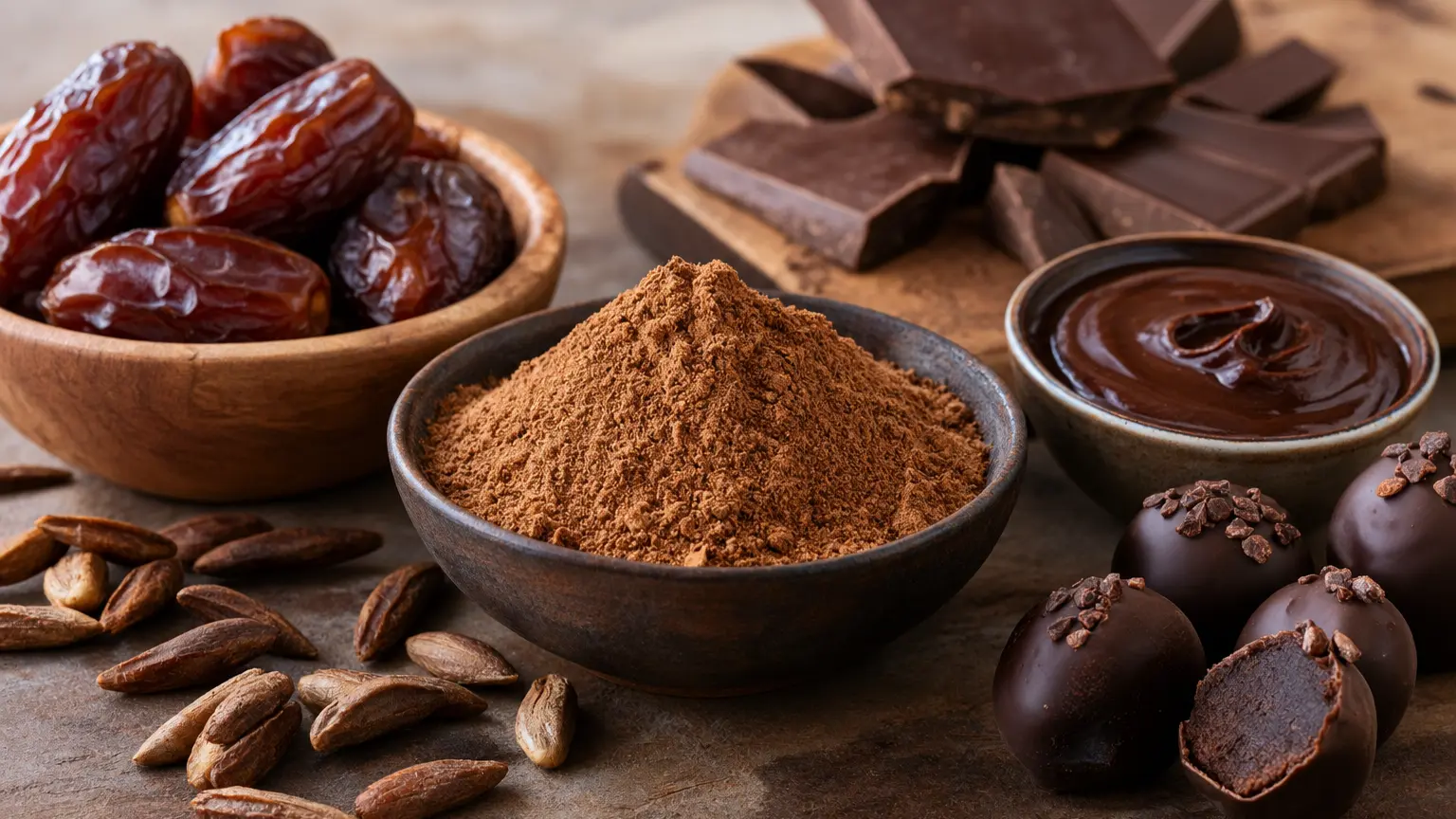
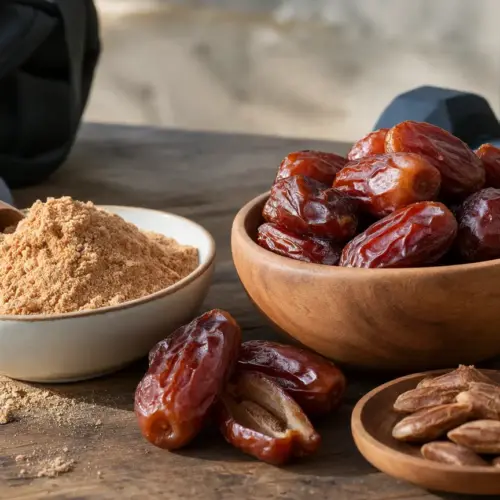
Roasted, finely milled date seed powder as a flavor platform for dark chocolate, spreads and truffle centers.
Roasted date seed powder is best known as a caffeine-free coffee alternative. Food researchers are now testing it in dark chocolate, chocolate spreads and truffle centers.
For chocolate manufacturers, its value is sensory. A finely milled, roasted powder adds coffee-like, toasted, nutty and caramel notes. It can also support a clean-label product concept when the full ingredient and regulatory requirements are met.
| KEY TAKEAWAYS FOR R&D AND PRODUCT TEAMS • Dark chocolate: replacing 25% of the cocoa-powder fraction scored 9.83/10, close to the 10/10 control.[4] • Chocolate spread: 4% date seed powder gave the best taste, aroma and texture.[5] • Particle size: use about 150–200 µm as a starting sieve specification for the incoming powder; refine the final chocolate mass much finer to control grit.[1] • Positioning: use it as a flavor ingredient, not as a 1:1 cocoa replacement. |
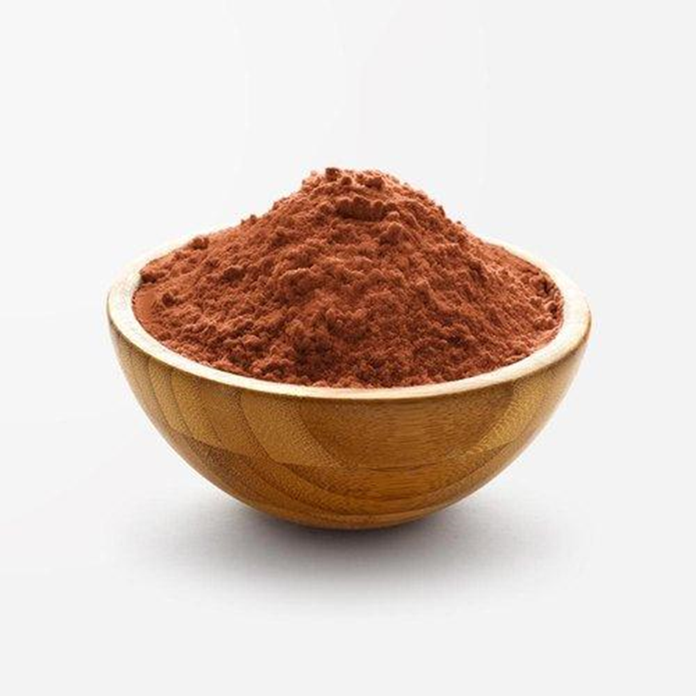
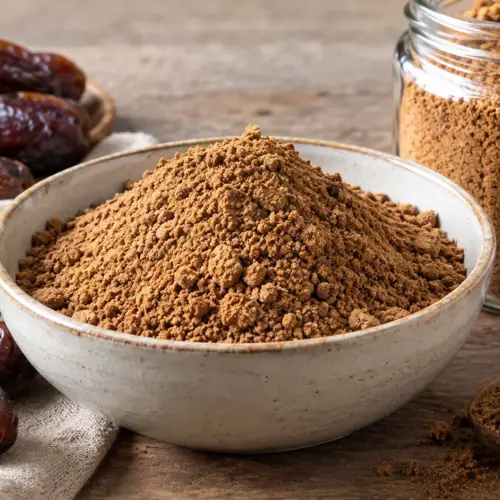
Roasted date seed powder: a natural ingredient from date-processing streams that adds coffee and caramel notes to chocolate.
What is date seed powder?
Date seed powder, also called date pit powder, is made from the seed inside the date. The seeds are cleaned, dried, roasted and finely milled.
It should not be confused with date fruit powder. Date seed powder is darker, less sweet and more strongly roasted. Its performance depends on the date variety, roast profile, moisture, fat content and particle size.
What does date seed powder add to chocolate?
A roasted, cocoa-like flavor profile
Roasting drives the flavor. Fikry et al. found that roasting conditions strongly affect color, aroma, taste and overall preference.[2] A later study linked roasted date seeds with pyrazines and furans, the compounds behind roasted, cocoa, nutty and caramel notes.[3]
Smooth texture with fine milling
A powder around 150 µm can be a practical starting specification for the incoming date-seed ingredient in spreads, centers or a pilot sieve step.[1] It should not be treated as the final particle size of a molded chocolate: particles above roughly 25–35 µm can be perceived as sandy or gritty. For a smooth chocolate mass, refine and conch the full formulation, then verify the particle-size distribution, commonly targeting a D90 below 30 µm and often 15–25 µm depending on the product and equipment.
Research-backed chocolate applications
1. Dark chocolate: start with 25% of the cocoa-powder fraction
Bashir roasted date seeds at 160°C for 30 minutes, milled them and passed them through a 60-mesh sieve. The powder then replaced 25%, 50% and 75% of the cocoa-powder fraction.[4]
The 25% dark chocolate scored 9.83/10 for overall acceptability, against 10/10 for the control. This supports 25% as a useful first pilot level.
| TECHNICAL CHECK • Add the powder with the cocoa solids, then temper and mold as usual. Compare 0%, 25% and 50%. Check snap, bloom, aroma, bitterness and aftertaste. |
2. Chocolate spread: start at 4%
Tlay and Al-Baidhani tested 2%, 4% and 10% date seed powder in chocolate spread. The 4% version scored best for taste, aroma and texture. The cocoa control scored better for color.[5]
| TECHNICAL CHECK • Use fine sieving and high-shear mixing. Measure viscosity, oil separation and grit, and monitor storage stability. Higher levels may need adjustments to oil, lecithin, sugar or vanilla. |
3. Truffle and chocolate-ball centers
The same study tested the powder in a center made with crushed biscuit, cocoa and condensed milk, replacing 25%, 50% or 75% of the cocoa.[4]
This format is easy to test: the center carries the roasted note, while a familiar dark chocolate shell controls the final taste. Good pairing ideas include dates, pistachio, tahini, orange zest and sea salt.
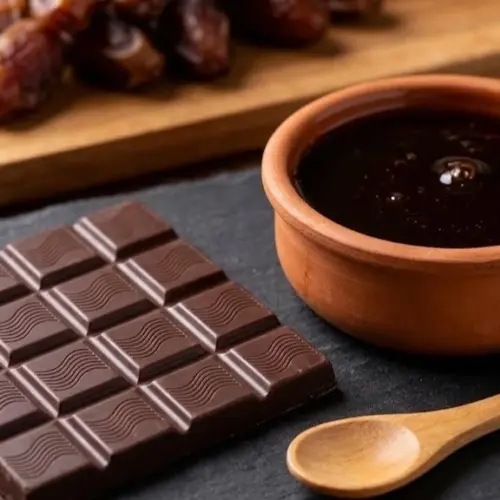
Truffle centers are an easy first format for testing roasted date seed powder in chocolate.
Industrial pilot formulas for 100 kg batches
The formulas below translate the published inclusion levels into 100 kg pilot batches. They are starting points for product development, not finished commercial specifications. Values are in % w/w, which equals kg per 100 kg batch.
| Ingredient | Dark chocolate bar | Chocolate spread | Truffle center |
| Cocoa mass | 41 | – | – |
| Cocoa butter | 20 | – | 8 |
| Sugar | 30 | 35 | 8.5 |
| Cocoa powder | 6 | 8 | 6 |
| Date seed powder | 2 | 4 | 2 |
| Hazelnut paste | – | 10 | – |
| Vegetable fat | – | 25 | – |
| Neutral oil | – | 7 | – |
| Milk powder | – | 10 | – |
| Biscuit or cereal | – | – | 35 |
| Condensed milk | – | – | 25 |
| Nut paste | – | – | 15 |
| Lecithin | 0.6 | 0.5 | – |
| Vanilla | 0.3 | 0.3 | 0.3 |
| Salt | 0.1 | 0.2 | 0.2 |
| Total | 100 | 100 | 100 |
| PILOT DESIGN NOTES • Dark chocolate bar: 2 kg of date seed powder equals 25% of the cocoa-powder fraction. Run three versions (0%, 2% and 4%) and compare taste, aroma, color and texture after refining, conching, tempering and molding. • Chocolate spread: based on the 4% sensory lead.[5] Check viscosity, oil separation, grit and 9–12-month stability. • Truffle center: 25% replacement of the cocoa-powder fraction. Enrobe in dark chocolate and measure water activity, firmness and shelf life. |
Process route and technical specifications
For scale-up, roast, cool, mill and sieve the seeds in controlled batches. Standardize moisture, particle size and roast color before each use, then add the powder with the cocoa solids during refining.
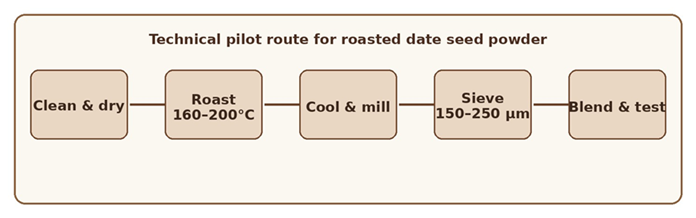
Pilot process for roasted date seed powder, from clean seeds to a tested chocolate ingredient.
| Parameter | Starting point | Why it matters |
| Roasting | 160–200°C, 20–30 min | Controls color, hardness and roasted aroma |
| Particle size | Incoming powder: about 150–200 µm; final chocolate: verify D90 <30 µm, often 15–25 µm | Separates sieve specification from final mouthfeel target |
| Inclusion level | 2–4% of finished product, or 25% of the cocoa-powder fraction | Creates a controlled sensory test ladder |
| Quality checks | Moisture, color, microbiology, contaminants, viscosity, bloom, snap, bitterness, shelf life | Confirms food safety and scale-up readiness |
Market outlook in Europe and the United States
Date seed powder is slowly gaining ground in Europe, the UK and the US as a natural, caffeine-free ingredient from date-processing streams. Buyers value its roasted notes of coffee, cocoa and caramel for drinks, bakery, functional foods and chocolate.[6–9]
European suppliers already sell roasted, milled date seed powder, including Tunisian origin, which shows that a supply channel exists.[11] In the US, demand is still emerging but fits current interest in coffee alternatives, natural ingredients and circular-economy sourcing.
There are no reliable public figures yet on sales volumes or growth.[10] For a commercial launch, manufacturers should require consistent quality, the right particle size, full traceability and compliance with EU or US food regulations.
FAQ: date seed powder for chocolate manufacturers
Can date seed powder replace cocoa powder?
Partly. Studies show good results when it replaces about 25% of the cocoa-powder fraction. It works best as a flavor ingredient, not as a full 1:1 cocoa replacement.[4]
Does date seed powder contain caffeine?
No. Date seed powder is naturally caffeine-free, which is why it is popular as a coffee alternative.
What does date seed powder taste like in chocolate?
It adds roasted, coffee-like, nutty and caramel notes. The intensity depends on the roast profile and the date variety.[2][3]
What particle size is best for chocolate?
For the incoming powder, start around 150–200 µm after sieving. For a smooth molded chocolate, refine and conch the complete formulation and verify a final D90 below 30 µm, often 15–25 µm depending on the product.[1]
Is date seed powder the same as date powder?
No. Date powder is made from the fruit flesh and is sweet. Date seed powder comes from the roasted seed and is darker, less sweet and more roasted.
Conclusion: a new flavor platform for chocolate
Roasted date seed powder is more than a coffee substitute. In chocolate, it adds toasted notes and opens the way to new dark chocolate profiles with a new product story.
The best starting points are a 25% cocoa-fraction replacement in dark chocolate, a 4% spread trial and a fine-particle pilot. Public market data for this specific ingredient are still limited, but the formulations can be tested under controlled development conditions.
| NEXT STEP FOR PRODUCT DEVELOPMENT • Request a technical data sheet, pilot samples and bulk-pricing information from a qualified supplier. |
References
[1] Review of date-pit food applications and particle size (Frontiers in Sustainable Food Systems, 2022)
[2] Fikry et al. (2019): roasting conditions and sensory attributes of coffee-like date seed powder (Foods)
[3] Shi et al. (2025): roast intensity, cultivar and volatile compounds of date seeds (Foods)
[4] Bashir: Utilization of date seed powder in food manufacturing (RSC Sustainable Food Technology)
[5] Tlay and Al-Baidhani (2023): date seed powder in chocolate spread
[6] Alamri et al. (2024): date-processing streams and sustainable food applications
[7] Phenolic compounds in date fruit and date-derived materials (2025)
[8] Valorization of date palm fruits and date-derived materials (2026 review)
[9] Physicochemical characteristics of date seed powder–starch composites (2025)
[10] CBI: European market potential for dates
[11] European supplier listing for roasted organic date seed powder (availability signal only)
[12] Ingredients Network: fruit-based date powder listing (not evidence of date seed powder sales)
 English
  Spanish
  French
  Italian
  German