


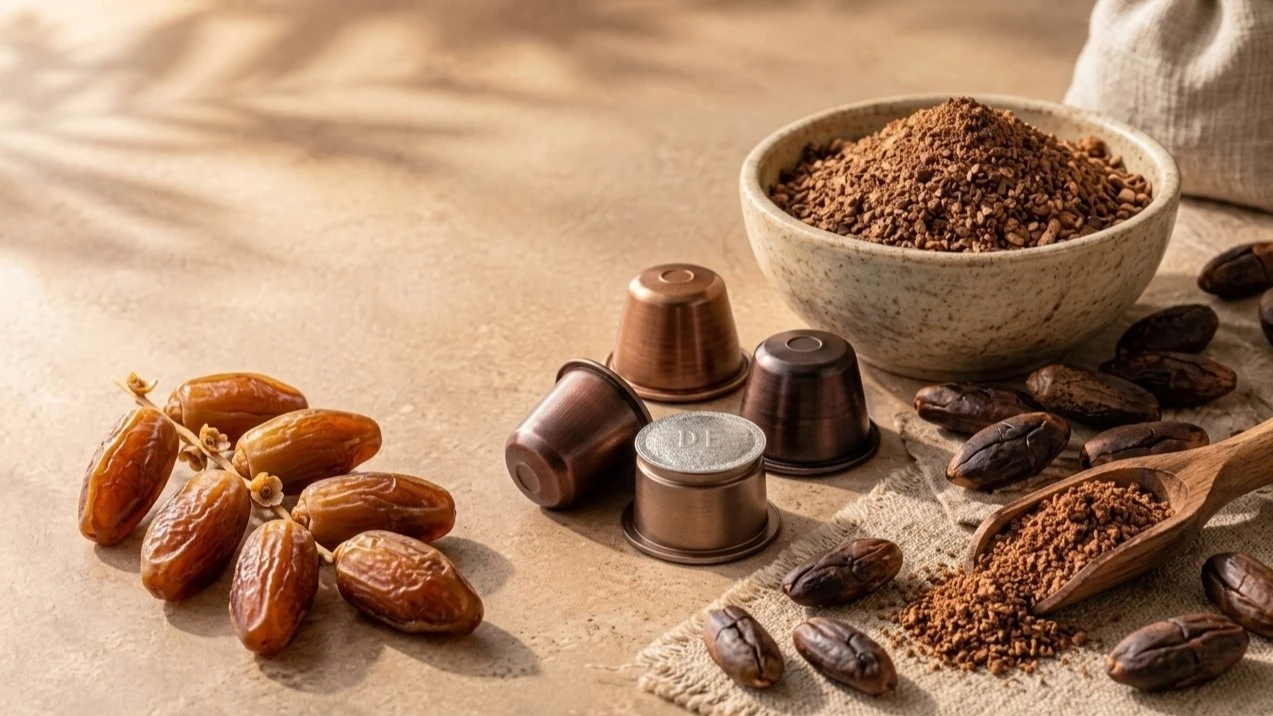
What if date seed powder could become the basis of a new generation of caffeine-free coffee alternatives?
Coffee capsules offer a convenient way to prepare a hot beverage at home. At the same time, consumers are showing growing interest in caffeine-free products, plant-based ingredients and more sustainable food systems. These trends are creating opportunities for agri-food innovation teams to develop new beverages made from distinctive, naturally caffeine-free ingredients such as date seed powder.
One promising ingredient is date seed powder.
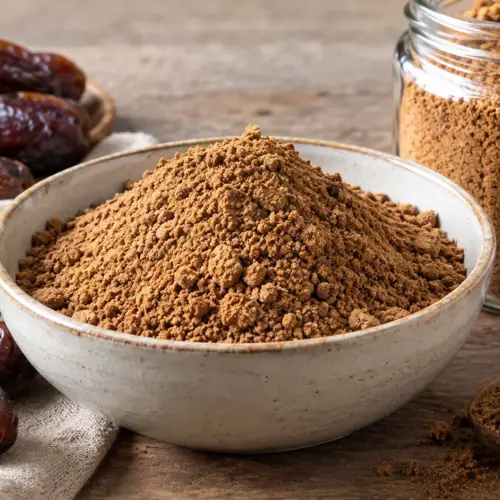
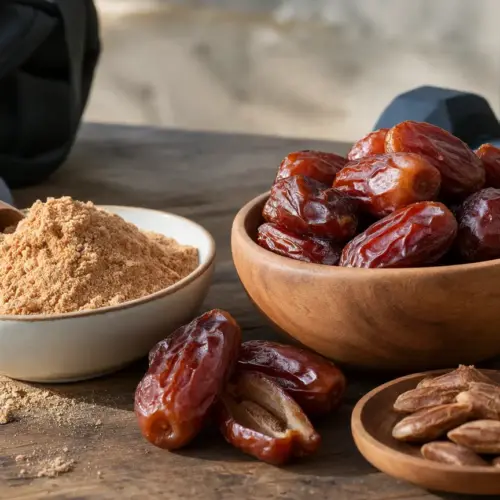
Date seeds can be cleaned, roasted and ground into a dark, fine powder with a roasted aroma and a coffee-like flavour. Date seed powder can be developed as a versatile food and beverage ingredient. Beyond coffee capsules, it may be explored in instant beverage mixes, filter-bag drinks, bakery products, cereal formulations, snacks and other plant-based applications. The appropriate use will depend on the powder’s particle size, roasting profile, flavour intensity, stability and formulation performance. Research has also reported phenolic compounds and measurable antioxidant activity in laboratory tests, giving the powder a distinctive functional and sensory profile.
What Does the Research Show About Date Seed Powder?
A 2019 study by Warnasih and colleagues examined a coffee-style beverage prepared from roasted date seed powder made from the Red Sayer date variety (Phoenix dactylifera L.). The researchers reported that the roasted date seed powder contained no detectable caffeine under the conditions of their analysis. [1]
The study also reported a total phenolic content of 340.65 mg GAE per 100 g, along with measurable antioxidant activity in the DPPH laboratory assay. The researchers also identified the carbohydrates, proteins and fats naturally present in the roasted date seed powder:
| Parameter | Reported result |
| Water | 4.42 ± 0.01% |
| Ash | 1.17 ± 0.04% |
| Protein | 8.55 ± 0.64% |
| Fat | 7.34 ± 0.07% |
| Total sugar | 16.39 ± 0.01% |
| Carbohydrate | 78.52 ± 0.76% |
| Caffeine | Not detected |
| Total phenol | 340.65 ± 1.53 mg GAE/100 g |
| Antioxidant activity (IC50) | 23.81 ± 0.22 µg/mL |
GAE = gallic acid equivalents, a standard unit used to express the amount of phenolic compounds measured in a sample.
These findings are scientifically interesting, but they should be interpreted carefully. Results from a laboratory antioxidant assay do not establish a specific health benefit in humans. They show only that the tested roasted date seed sample contained compounds with measurable activity under the conditions of the experiment. The absence of detectable caffeine should likewise be understood as a result from this cited study, not as a universal guarantee for every date seed product — any commercial formulation would need to be tested independently.
The exact composition may vary according to the date variety, growing conditions, processing method and roasting conditions.
Why Is Date Seed Powder Relevant for Agri-Food Innovation?
Building a dedicated supply chain around date seeds also supports a more resource-efficient food system. Environmental performance would still depend on collection, cleaning, drying, roasting, grinding, packaging and transport, so sustainability claims should always rest on a full assessment rather than on the ingredient’s origin alone.
The combination of a distinctive flavour profile, a caffeine-free composition and measurable antioxidant activity gives agri-food innovation teams a strong scientific and sensory foundation to build on.
Date Seed Powder Sensory Profile: A Key Focus for Product R&D
A beverage made from roasted date seed powder is not a direct substitute for Arabica or Robusta coffee. It is better positioned as a coffee-style beverage or caffeine-free coffee alternative, with roasted, slightly bitter notes and a nutty edge.
Roasting temperature directly affects colour and sensory profile: a study by Babiker and Özcan compared samples roasted at 180, 200 and 220°C for 20 minutes, finding distinct sensory outcomes at each level. [2] Farag et al. identified several classes of volatile compounds generated during roasting — furans, pyrans, terpenoids, sulfur compounds — that shape the final aroma. [3]
R&D implication: product development should include controlled roasting trials paired with structured sensory testing on a target consumer panel before any scale-up.
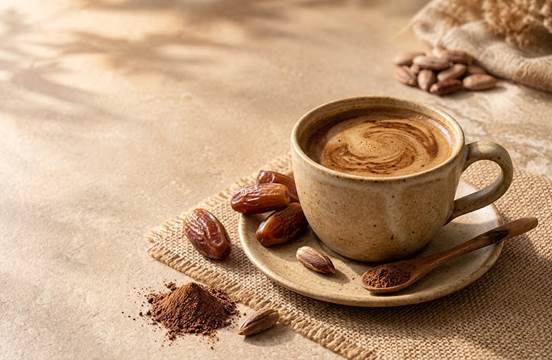
Coffee-style beverage prepared from roasted date seed powder
Date Seed Powder for Coffee Capsules
One promising application for date seed powder is a single-serve capsule designed to prepare a caffeine-free coffee-style beverage.
Roasted date seed powder can be optimised and formulated for capsule use, provided that its particle size, moisture content, density and extraction performance are carefully controlled. The concept would still require technical validation before it could become a reliable commercial product.
- Particle-size distribution of the powder
- Powder density and capsule fill weight
- Moisture content and storage stability
- Water flow and extraction time
- Compatibility with the target coffee-machine system
- Packaging barrier against moisture, oxygen and loss of aroma
- Batch-to-batch flavour consistency
- Shelf-life, food safety and manufacturing requirements
Capsules are not the only possible format. Date seed coffee could also be developed as a loose powder, filter-bag beverage, instant-style preparation or ingredient for other food and beverage applications.
This makes date seed powder a promising ingredient for manufacturers seeking a distinctive, plant-based and naturally caffeine-free coffee capsule concept.
Date Seed Powder as a Ready-to-Develop Food Ingredient
Date seeds are generated in significant volumes wherever pitted dates, date paste and date syrup are produced. Processors can collect, clean, dry, roast and grind them into a distinctive date seed powder with a defined sensory, compositional and phenolic profile.
This approach positions date seeds as a genuine ingredient category in their own right, opening a new value stream for date processors and food innovators alike. A responsible development strategy for agri-food innovation teams typically follows this sequence:
1. Ingredient characterisation and food-safety assessment
2. Roasting optimisation
3. Sensory evaluation
4. Formulation trials
5. Shelf-life testing
6. Consumer research
Sustainability claims should be supported by an assessment of the full production chain, not based solely on the origin of the ingredient.
The Commercial Opportunity for Date Seed Powder
Date seed powder brings together several relevant trends: caffeine-free beverages, plant-based ingredients, upcycled food materials, phenolic-rich formulations and convenient single-serve formats.
The most promising areas for investigation include roasting conditions, particle size, flavour consistency, capsule formulation, preparation performance and consumer acceptance.
The product proposition: date seed powder is a naturally caffeine-free, roasted ingredient with a distinctive coffee-like sensory profile. With appropriate processing and validation, it can serve as the basis for coffee capsules, beverage mixes and other innovative food applications.
For date processors, food innovators and capsule manufacturers, the opportunity lies in developing products based on date seed powder: a distinctive, plant-based and naturally caffeine-free ingredient with potential applications across the beverage and food sectors.
Scientific References
[1] Warnasih et al. (2019). Chemical Characteristics, Antioxidant Activity, Total Phenol, and Caffeine Contents in Coffee of Date Seeds (Phoenix dactylifera L.) of Red Sayer Variety. Journal of Pure and Applied Chemistry Research, 8(2), 179–184. DOI: 10.21776/ub.jpacr.2019.008.02.475.
[2] Babiker & Özcan (2020). Bioactive Compounds, Minerals, Fatty Acids, Color, and Sensory Profile of Roasted Date (Phoenix dactylifera L.) Seed. Journal of Food Processing and Preservation, 44(7), e14495. DOI: 10.1111/jfpp.14495.
[3] Farag et al. (2019). Sensory Metabolite Profiling in a Date Pit Based Coffee Substitute and in Response to Roasting as Analyzed via Mass Spectrometry Based Metabolomics. Molecules, 24(18), 3377. DOI: 10.3390/molecules24183377.
Editorial article prepared for informational purposes • September 2026
 English
  Spanish
  French
  Italian
  German