


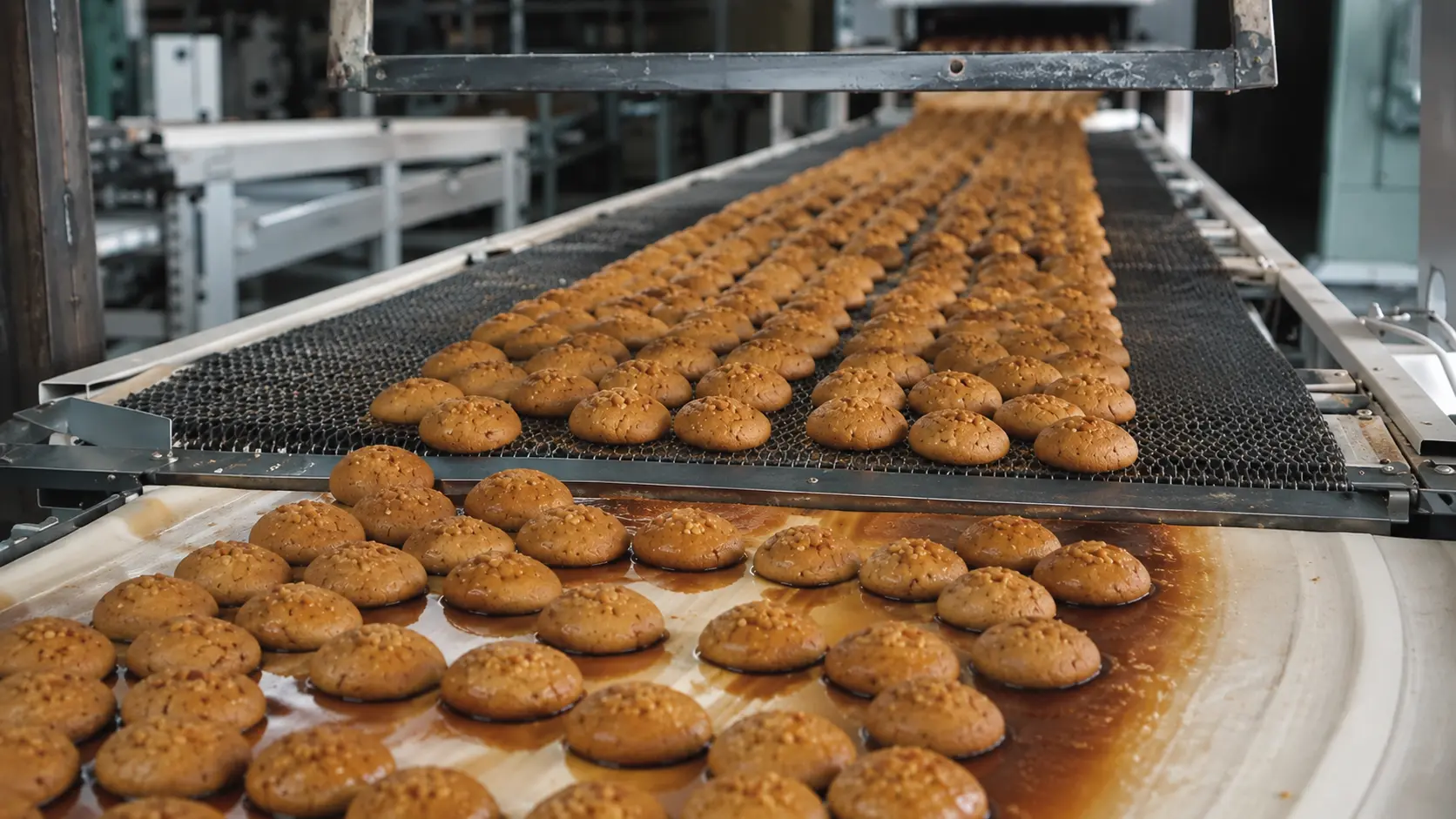
| At a glance Range: screen 10%, 20% and 30% sugar replacement, weight for weight. Method: one date-powder lot and one formulation or process change at a time. Decision: select the highest level that passes process, quality, acrylamide and shelf-life checks. |
Date powder does not behave like sucrose. Its reducing sugars, fibre and fruit solids can change water demand, spread, colour, texture and flavour. The purpose of a pilot is to isolate those effects before the formula is optimised.
For ingredient composition, application fit and broader labelling guidance, start with Date Powder as a Natural Sweetener: Applications, and key considerations
What the research supports
| Source | Evidence reviewed | Practical interpretation |
| Mubarak et al. (2022) | 20%, 30% and 50% sugar replacement | Water absorption increased; 30% was the most accepted tested level.[1] |
| Ranasinghe (2022) | Review of date ingredients in baked goods | Product response depends on dose, date material, recipe and process.[2] |
These findings support a moderate screening range. They do not replace a product-specific pilot, because flour, fat, leavening, powder specification and oven profile can change the result.
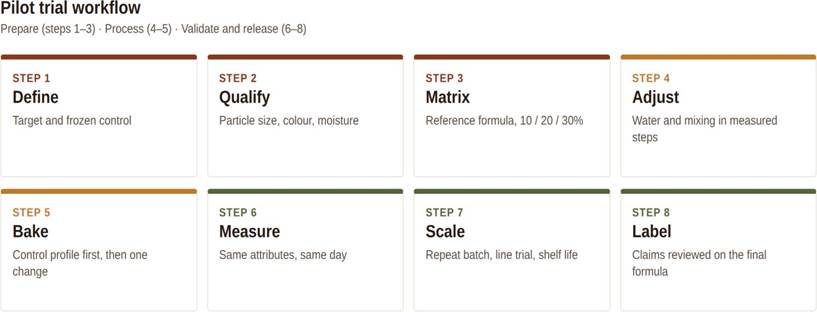
Figure 1. The eight-step pilot sequence.
Step 1. Define the target and freeze the control
Set one measurable objective before mixing. For example: “Replace 20% of the refined sugar while keeping the control’s machinability, dimensions and break force.”
Bake the current full-sugar formula as the control. Record ingredient lots, mixing sequence and time, dough temperature, resting time, piece weight, oven zones, belt speed, exit moisture, colour and break force.
Step 2. Qualify the date powder
Use one lot for the full series and keep a sealed reference sample. Agree incoming limits with the supplier and adapt them to the biscuit type and feeding system.
| Parameter | Illustrative incoming target | Why it matters |
| Particle size | Starting target: D90 ≤ 250 µm for thin or rotary-moulded biscuits | Surface, mouthfeel and mould release |
| Colour | Starting tolerance: ±3 L* versus the approved reference lot | Finished biscuit colour between lots |
| Moisture | Starting target: ≤5% | Caking, flow and dosing accuracy |
| Sugar profile | Declared on the certificate of analysis | Sweetness, browning and acrylamide assessment |
| Microbiology | Within the manufacturer’s specification | Food safety and shelf life |
These values are screening specifications, not universal limits. Confirm them against the supplier method, equipment capability and finished-product target.
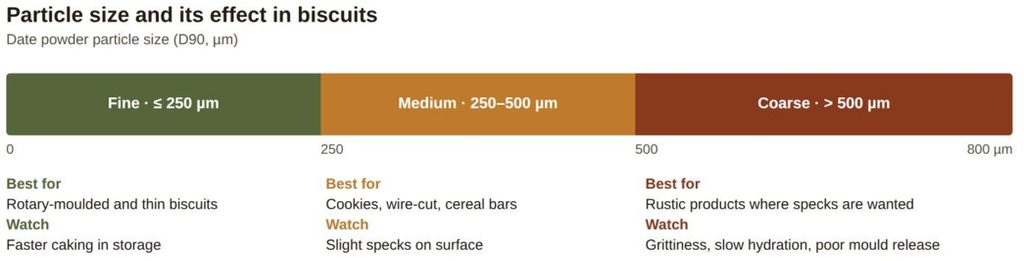
Figure 2. Match the powder grade to the biscuit and verify it by sieving or laser diffraction.
Step 3. Build the replacement matrix
Keep the first screen simple: replace refined sugar weight for weight and leave the other ingredients unchanged. For a 100 kg formula containing 20 kg of refined sugar, use the following matrix.
| Batch | Sugar replaced | Refined sugar | Date powder |
| Control | 0% | 20 kg | 0 kg |
| Trial A | 10% | 18 kg | 2 kg |
| Trial B | 20% | 16 kg | 4 kg |
| Trial C | 30% | 14 kg | 6 kg |
Test 40% only if Trial C remains within every agreed limit. Avoid 100% replacement in a first industrial trial because sweetness, water demand, spread, colour and texture move at the same time.
The full 100 kg reference formula and process sheet are retained in Appendix A.
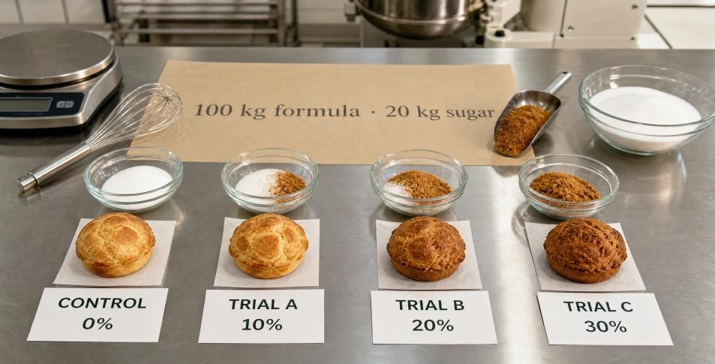
. Photo2:. Control and trials at 10%, 20% and 30% date powder: compare shape and colour before changing oven settings
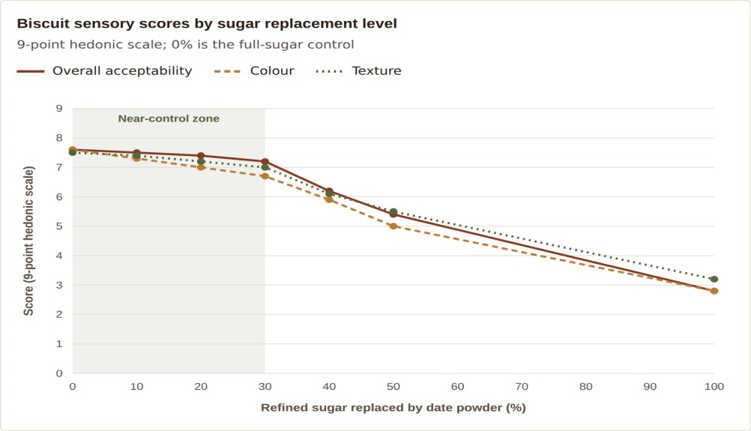
Figure 3. Scores stay near the control up to 30% replacement, then fall sharply. Colour declines first.
Step 4. Adjust water
Run the first comparison at the control’s water level. If the trial dough falls outside the control band, add water in small measured increments until the agreed consistency is restored.
Use an objective endpoint where possible, such as mixer torque, penetration or a defined sheeting response. Record total water added and final dough temperature. Do not change fat, flour and water in the same trial.
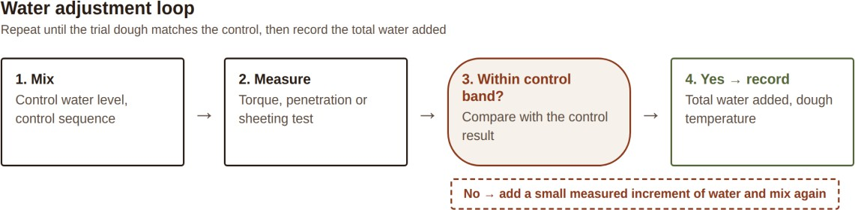
Figure 4. Keep the original mixing sequence and use an objective endpoint.
Step 5. Bake in a controlled sequence
Bake the first series at the control settings to reveal the direct effect of the powder. If colour runs ahead of the target bake, change one variable—time, temperature or piece thickness—then repeat the full measurement set.
| Situation | Action |
| First series | Control time, temperature, belt speed and piece weight |
| Colour runs ahead | Change one factor: time, temperature or thickness |
| After each change | Repeat every measurement listed in Step 6 |
Step 6. Measure every batch the same way
Test the control and trials on the same day with the same methods. Set acceptance limits before reviewing the results.
| Attribute | Method |
| Powder at goods-in | Particle size and L*a*b* colour |
| Dough | Torque, penetration or agreed line test |
| Dimensions | Weight, diameter, thickness and spread ratio |
| Texture | Break force at a fixed conditioning time |
| Colour | L*a*b* values plus an approved visual standard |
| Moisture and water activity | Validated moisture method and aw meter |
| Sensory | Blind coded panel with a defined scorecard |
| Acrylamide | Accredited laboratory method |
Step 7. Select the formula and scale it
Select the highest replacement level that meets every must-have criterion—not the trial containing the most date powder. Confirm it in a repeat pilot before moving to the line.
| Stage | Verify |
| Repeat batch | Reproducibility against the selected pilot |
| Stage | Verify |
| Line trial | Feeding, mixing load, moulding, release, oven and cooling |
| Yield | Finished weight after the water adjustment |
| Shelf life | Final pack: aw, texture, flavour and microbiology |
| Change control | Revalidate after a material powder or supplier change |
Step 8. Check the claims on the final formula
Claims are assessed on the finished product, not on the percentage of refined sugar replaced.
| Claim | Position | Condition |
| “Sugar-free” | No | Date powder contains sugars |
| “No added sugars” | Normally no | The condition is not met when date powder is added for sweetening |
| “Reduced sugars” | If proven | At least 30% less sugar and no more energy than a similar product; a 30% swap alone is not proof |
| “Sweetened with dates” | Potentially | Use only when it reflects the recipe and overall presentation |
Regulation (EC) No 1924/2006 sets the EU conditions for nutrition claims.[4] Complete a market-specific legal review before pack use.
Five mistakes that make the trial hard to interpret
Starting at 100% replacement instead of mapping a moderate range. Correcting water, fat and flour at the same time.
Changing date-powder lot or particle-size grade during the series.
Approving on colour or taste without water activity, shelf-life and acrylamide checks. Treating a replacement percentage as proof of a nutrition claim.
PILOT WORKSHEETS
Appendix A. Reference formula and process sheet
Illustrative rotary-moulded short-dough formula. The baking profile and exit moisture must be adapted to the product and line.
| kg per 100 kg batch | Control | A — 10% | B — 20% | C — 30% |
| Soft wheat flour (9–10% protein) | 55.0 | 55.0 | 55.0 | 55.0 |
| Refined sugar, fine | 20.0 | 18.0 | 16.0 | 14.0 |
| Date powder | 0.0 | 2.0 | 4.0 | 6.0 |
| Vegetable fat (biscuit shortening) | 15.0 | 15.0 | 15.0 | 15.0 |
| Skimmed milk powder | 1.5 | 1.5 | 1.5 | 1.5 |
| Salt | 0.5 | 0.5 | 0.5 | 0.5 |
| Sodium bicarbonate | 0.3 | 0.3 | 0.3 | 0.3 |
| Ammonium bicarbonate | 0.4 | 0.4 | 0.4 | 0.4 |
| Lecithin | 0.3 | 0.3 | 0.3 | 0.3 |
| Water | 7.0 | 7.0 + adjustment | 7.0 + adjustment | 7.0 + adjustment |
Process sheet
| Stage | Instruction |
| 1. Creaming | Fat, sugar, date powder and lecithin: about 3 min, slow |
| 2. Liquids | Salt and ammonium bicarbonate dissolved in cold water |
| 3. Dry ingredients | Flour, milk powder and sodium bicarbonate: about 2 min, short mix |
| 4. Dough | 20–22 °C; consistency checked against the control |
| 5. Moulding | Rotary moulding at the control piece weight |
| 6. Baking | Illustrative starting point: about 200–220 °C for 6–8 min; use the control profile |
| 7. Cooling | Cool to ambient; define the product-specific exit-moisture target |
Appendix B. Batch record
| Batch | Water added | Dough temp. | Bake profile | Diameter / thickness | Break force | L* | aw | Pass |
| Control | ||||||||
| Trial A | ||||||||
| Trial B | ||||||||
| Trial C |
References
- Mubarak, A.H. et al. (2022). “Effect Replacing Sugar With Date Powder On Biscuit Quality.” Journal of Pharmaceutical Negative Results, 13(S07), 1755–1770. Open source
- Ranasinghe, M. (2022). “Date Components as Promising Plant-Based Materials to Be Incorporated into Baked Goods—A Review.”
Sustainability, 14(2), 605. Open source
- Commission Regulation (EU) 2017/2158 establishing mitigation measures and benchmark levels for the reduction of acrylamide in food. Open source
- Regulation (EC) No 1924/2006 on nutrition and health claims made on foods. Open source
 English
  Spanish
  French
  Italian
  German